
French high school student movement: what the numbers say, far from the immigration trial
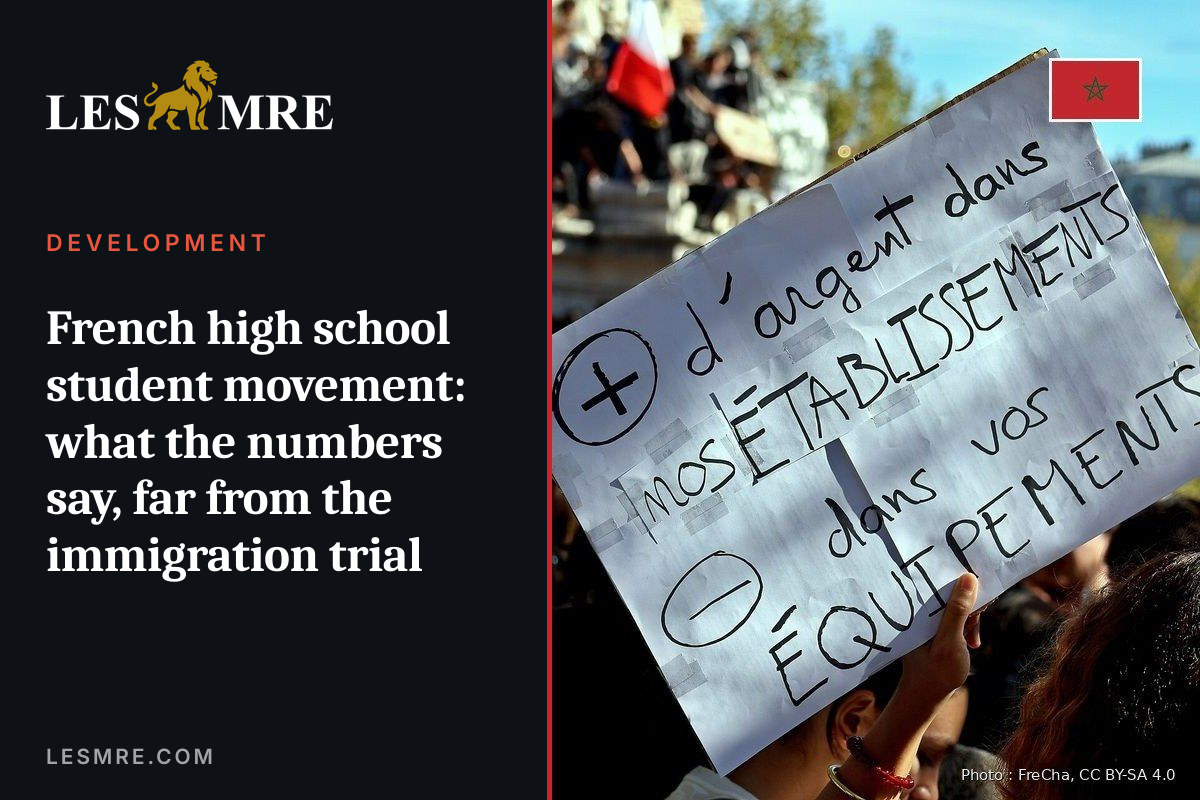
Since September, high schools in France have been blocked. Demands are school-related: absent teachers, overcrowded classes, Parcoursup. No religious or identity demands. The movement started in Brittany and Créteil. Some politicians blamed immigration and Islam, but official data provides no origin information on those arrested.
Since the start of September, there have been blockaded schools, demonstrations across France and violence on the fringes of marches. A few voices were quick to find a culprit: immigration, Islam, the children of immigrants. The facts, however, tell a different story. Here is what is established, source by source.
A movement born in the classroom
The school students' demands are academic: absent teachers who are not replaced, staff shortages, dilapidated buildings, overcrowded classes, timetables, the pressure of Parcoursup. This is what the Odoxa institute notes, and it is on this ground that the government responds: on 2 October, it abandoned plans to charge enrolment fees for BTS and preparatory classes, and Sébastien Lecornu then opened five areas of work (teaching conditions, school hours, buildings, Parcoursup, student democracy).
There are no religious or identity-based demands. The AFP dispatch of 6 October says it in so many words: no "link has been made between this movement and religious or identity-based demands".
Started in Brittany before Créteil, spread across France
The first recorded blockage did not take place in the Paris suburbs. On 7 September, students at the Théodore-Monod school in Le Rheu, Ille-et-Vilaine, blockaded their establishment over timetable problems (France 3). The movement then gained momentum in Créteil, at the Saint-Exupéry school, where teachers went on strike on 17 September over unfilled posts.
It then spread across the whole country. On 6 October, Euronews cited blockades in Lyon, Nice, La Roche-sur-Yon, Rennes, Toulon, Strasbourg, Marseille, Aix-en-Provence, Lens, Réunion and Mayotte, as well as in Paris at the Louis-le-Grand and Henri-IV schools, among the most prestigious in the country. Private education was affected, as were medium-sized towns: Besançon, Tours, Belfort, Carpentras.
According to the Ministry of the Interior, 1,027 establishments were affected on 1 October, out of approximately 3,700 secondary schools. On 6 October, it counted 256,000 demonstrators (450,000 according to the organisers).
Who blames immigration, and who does not
On 6 October, Donald Trump wrote on his Truth Social network: "What is happening in France is nothing other than uncontrolled mass immigration." Then: "This is not about the schools, this is about Islam." He provided no evidence.
In France, Philippe de Villiers declared to the JDD on 3 October: "These are the children of the great Migration and of Wokistan." On 7 October, according to AFP, Éric Zemmour pointed the finger at "the France of the banlieues, the largely Arab-Muslim France" and said he wanted to "make their parents pay until the end of time, even if it means taking it from their welfare benefits".
This link is made by neither the government nor the National Rally. Jordan Bardella and Marine Le Pen accuse La France insoumise of stoking the movement. Matignon speaks of "urban violence" and blames LFI and the far-left. None of their recorded remarks mention immigration or Islam.
What the official figures show
The Ministry of Justice published a report on 5 October: 5,060 people held in police custody, of whom 87% were minors (4,406). 1,802 people prosecuted, 14 placed in pre-trial detention, 790 cases dropped.
This report gives no data on the nationality or origin of those arrested. No official report provides it. Any claim about the origin of the young people arrested therefore rests on impression, not on a figure.
Public opinion, for its part, has made its mind up. According to Odoxa (1 October), 62% of French people consider the school students' mobilisation justified, and 73% among the under-35s. The same poll shows widespread disapproval of the violence and of LFI's involvement.
The 2023 precedent: young French people, often with no prior record
The rhetoric is not new. After the riots of summer 2023, following the death of Nahel, the same charges were made. The official data had refuted them. The Senate report no. 521, which draws on the analysis of the general inspectorates of administration and justice, establishes that:
- •among adults convicted, 71% were of French nationality and 75% born in France; they were 23 years old on average, and 57% had no prior criminal record;
- •among minors brought before the courts, 90% were of French nationality and more than 82% born in France; they were 16 years old on average, and 68.2% were facing prosecution for the first time.
The Senate itself warns that these data cover only those arrested and tried, and that they remain insufficient. But they in no way support the idea of a revolt coming from immigration.
What to take away
A school-based movement, started in Brittany and Créteil, spread to schools of all backgrounds and all regions, supported by a majority of French people and by teacher and parent associations, which moreover condemn the violence. Real violence, injuries among students, staff and police. And no official data linking this movement to the origins of those taking part in it.
For Moroccan families in France, the risk is not in this debate. It is more concrete: a young person arrested on the fringes of a blockade can pay for it well beyond the courtroom, especially if they do not have French nationality. We devote a separate article to this.
Sources: Ministry of Justice, communiqué of 5 October 2026; Ministry of the Interior; Odoxa, poll of 1 October 2026; AFP; Euronews, 6 October 2026; France 3; JDD, 3 October 2026; L'Étudiant, 6 October 2026; Senate, report no. 521 (2023-2024), "June 2023 riots: understand, assess, respond".
Related articles
Related practical guides
Are you an MRE?
Join the platform and reach verified professionals in Morocco. Free.
Have a project in Morocco?
Find a LesMRE-verified expert to guide you through your steps.
Find an expert →