
Commander Hakima Edahri, Moroccan peacekeeper in Goma: the women of the Royal Armed Forces serving peace
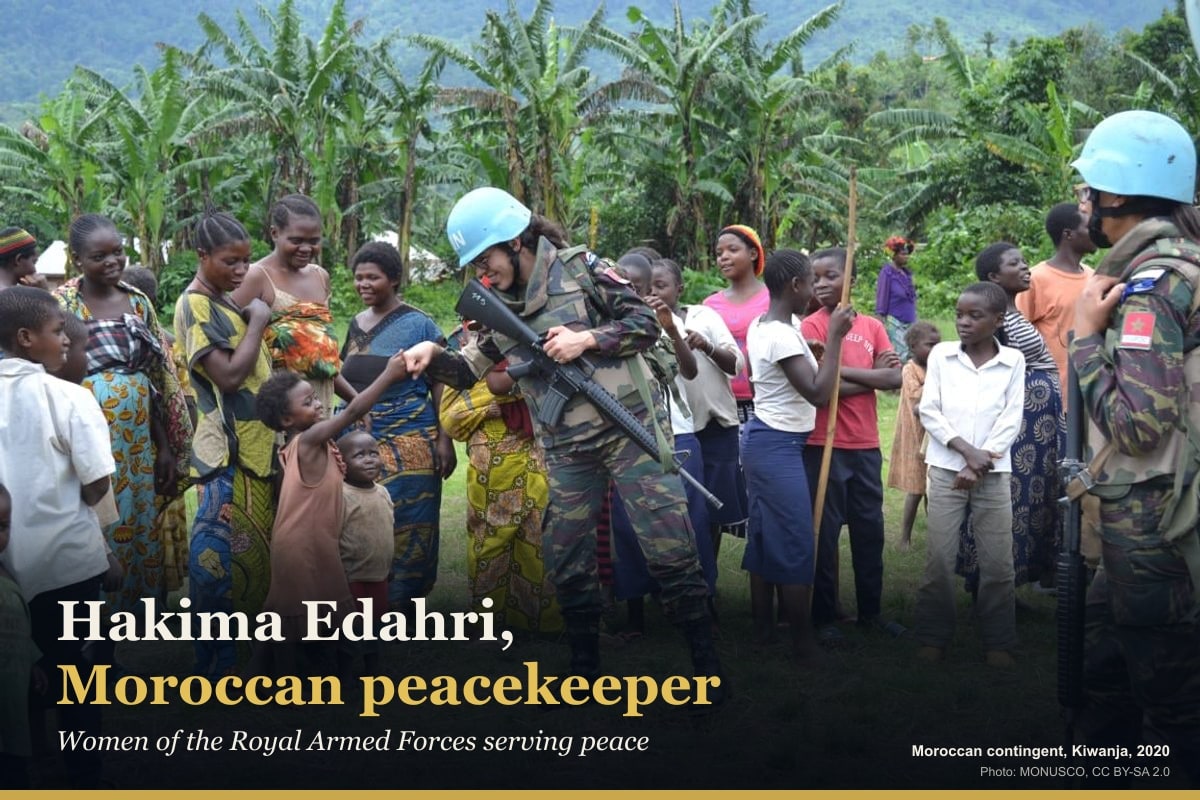
An officer of the Royal Moroccan Armed Forces and a mother of five, she protects civilians in North Kivu with MONUSCO. Her story tells of sixty-six years of Moroccan commitment to peace, and of the place women are taking in it.
In brief
- •Commander Hakima Edahri, 45, serves in Goma, in the Democratic Republic of the Congo, with the UN mission (MONUSCO). She heads the engagement section of the Moroccan battalion and is its gender focal point.
- •Morocco has sent peacekeepers since 1960. About 1,700 Moroccan troops serve today in the DRC and the Central African Republic.
- •Women of the Royal Armed Forces are taking a visible place there, and Morocco also trains female officers from other countries.
An officer in North Kivu
On 28 May 2026, for the International Day of UN Peacekeepers, MONUSCO published her portrait. It shows a 45-year-old woman, a mother of five, who has served in the Moroccan army since 1999.
She joined MONUSCO in October 2025. First in Kiwanja, in Rutshuru territory. Then in Goma, North Kivu’s main city, where armed violence is part of daily life.
Her job? Head of the engagement section of the Rapid Deployment Battalion of the Royal Armed Forces and gender focal point. Put simply, she is the link between the soldiers and the people. Women, local leaders, families. And the children, whom she sees through a mother’s eyes.
“The courage of the children of North Kivu reminds us why our mission is essential.”
She describes her environment as “demanding and deeply formative”. And when asked what keeps her going, the answer is short:
“My family is my greatest strength.”
Why a woman in this role changes everything
In a conflict zone, part of the population will not talk to a male soldier. Not about an assault, a threat or a missing child. To a woman in uniform, they will.
That is the whole point of Security Council Resolution 1325, adopted on 31 October 2000: women must be present in peace missions, because protecting civilians depends on it. A gender focal point is that open door.
The Moroccan contingent understood this long ago. For International Women’s Day 2020, in Kiwanja, the very place where Commander Edahri started her mission, it organised a day honouring the community’s women leaders, and a football match between the girls of two local schools.
Morocco, a peacekeeper since 1960
This commitment is not new. Morocco took part in its first peacekeeping operation in 1960, in the Congo, four years after the Royal Armed Forces were created. Since then, tens of thousands of Moroccan soldiers have worn the blue helmet, from Africa to the Balkans.
Today the Kingdom has 1,714 peacekeepers deployed with MONUSCO, in the DRC, and MINUSCA, in the Central African Republic. It ranks among the UN’s leading troop contributors.
That commitment has a cost. In June 2026, the UN posthumously honoured three Moroccan peacekeepers who died on duty, two in the Central African Republic and one in the DRC.
Morocco also trains other armies’ women
Morocco does more than deploy its own troops. It trains.
In Agadir, at the Southern Zone headquarters of the Royal Armed Forces, a three-week course ended on 22 August 2025. It brought together 23 female officers from 14 nationalities, mostly African, alongside officers from Europe and Canada. Designed with UN Women and the UN Department of Peace Operations, it prepares them for command posts in peace missions.
In other words, women officers from across the continent learn in Morocco the job Commander Edahri does in Goma.
For our daughters
For a young Moroccan woman born in Brussels, Lyon or Montreal, this portrait says something simple. The uniform of the Royal Armed Forces is worn by women too, up to positions of responsibility, and all the way to the blue helmet.
Commander Edahri puts it this way: as a Moroccan peacekeeper, she has the duty to serve peace and protect civilians.
Sources
- •“Hakima Edahri: restoring hope despite hardship and violence”, MONUSCO, 28 May 2026.
- •Morocco’s first peacekeeping participation, Congo 1960 (Le360).
- •Moroccan troops in MONUSCO and MINUSCA, and the UN tribute to three Moroccan peacekeepers (Morocco World News, June 2026).
- •Training course for women officers in Agadir (MAP via maroc.ma, Hespress, August 2025).
- •International Women’s Day 2020 in Kiwanja (MONUSCO photo library).
- •Cover photo: MONUSCO Photos, CC BY-SA 2.0, Wikimedia Commons.
Related articles
Related practical guides
Are you an MRE?
Join the platform and reach verified professionals in Morocco. Free.
Have a project in Morocco?
Find a LesMRE-verified expert to guide you through your steps.
Find an expert →