
Ceuta: Macron speaks of an “attack” without accusing Morocco, what the facts really say
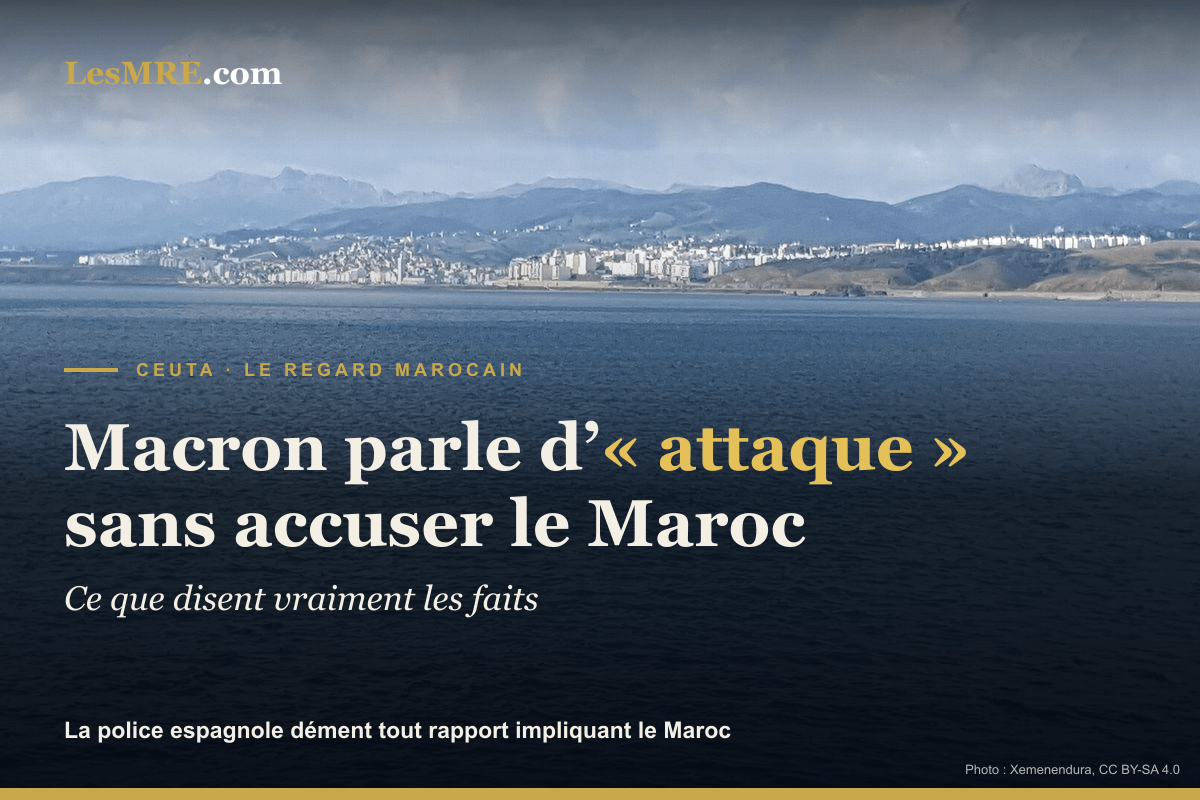
In Madrid on 30 September, Emmanuel Macron called July’s mass entry into Ceuta a “multiple attack”. He did not name Morocco and argued for cooperation with the Moroccan authorities. Spain’s police leadership denies any report implicating Morocco.
In short
- •On 30 September 2026 in Madrid, Emmanuel Macron said Spain had been “the victim of an attack” in Ceuta, a “multiple attack” organised, in his words, through social media.
- •He did not name Morocco, and he asked that migrant returns be organised in coordination with the Moroccan authorities.
- •Spain’s police leadership denies that any report attributes the planning of these events to Moroccan forces.
- •Morocco points out that no evidence implicates it and refuses to be used as a “pre-election political tool”.
What Macron said, word for word
At a joint press conference with Pedro Sánchez at the Moncloa Palace, the French President spoke about the mass entry into Ceuta on 30 and 31 July. According to the Spanish press and Euronews, he used two expressions: Spain was “the victim of an attack”, and it was a “multiple attack”, carried out through social media to push thousands of people, including minors, to attempt the crossing. He deplored 141 deaths.
Three points matter as much as the word “attack”:
- •Emmanuel Macron did not name Morocco as the perpetrator.
- •He described a mechanism run through social media, the same explanation as the Spanish government.
- •He wished migrant returns to take place in coordination with the Moroccan authorities, which implies a partner, not an adversary.
Why the word is a problem from Morocco’s point of view
The statement came in Madrid, five days before the Cortes were dissolved and early elections called for 29 November. Part of the Spanish opposition already accuses Morocco of organising these entries, and the Vox party is using it as a campaign argument. In that climate, the word “attack”, spoken without naming a perpetrator, lends itself to every reading, including the one Emmanuel Macron did not make.
A head of state who speaks of an attack without saying who attacked leaves others to complete the sentence, and some have every interest in doing so. This is exactly what Rabat fears when it refuses to be “the scapegoat of political score-settling”.
What the facts establish
Spain’s police leadership denies it. On 2 September 2026, the Director General of the National Police wrote to the Interior Minister that “no police report attributes to the Moroccan security forces the planning or execution” of these events. The document picked up by part of the press is a unit note sent to a judge of the Audiencia Nacional, which the police leadership disowned.
The Spanish government does not accuse Morocco. It attributes the influx to false rumours spread online and to smuggling networks, a reading that Emmanuel Macron’s own words match.
The human toll is heavy. About 80,000 people entered Ceuta according to the Spanish press, and 141 lost their lives according to the French President. This tragedy calls for a serious investigation, which Morocco is also asking for.
Morocco’s position
On 10 September 2026, Morocco’s Ministry of Foreign Affairs recalled:
- •that migration cooperation between the two countries has always been “coordinated and efficient”, saving lives and dismantling criminal networks, at the cost of human and material losses among Moroccan forces;
- •that “no evidence, facts or reports” establish any involvement of the Moroccan authorities;
- •that the July events call for a thorough investigation to establish the circumstances and identify any interference;
- •that Morocco “refuses to be used as a pre-election political tool”.
The ministry also recalled the weight of the relationship: Spain is Morocco’s leading economic partner, and Morocco is Spain’s second trading partner outside the European Union.
The Franco-Moroccan context
The Madrid statement does not call the relationship between Paris and Rabat into question. In July 2024, France recognised Morocco’s sovereignty over the Sahara, and the October 2024 state visit opened a “reinforced exceptional partnership”. Emmanuel Macron’s call to work with the Moroccan authorities on returns fits that logic of cooperation.
For MRE
This political debate changes nothing in the procedures of Moroccans living in Spain and France. For the practical consequences of Spain’s 29 November election, including the regularisation, see our article Spain’s snap election: what changes for Moroccans in Spain.
Sources
- •Press conference by Emmanuel Macron and Pedro Sánchez at the Moncloa, 30 September 2026 (Europa Press via Infobae, Euronews).
- •Letter from the Director General of the National Police to the Interior Minister, 2 September 2026 (Libertad Digital).
- •Spanish government position on the Ceuta influx (Euronews, 2 September 2026).
- •Statement by Morocco’s Ministry of Foreign Affairs, 10 September 2026 (Atalayar).
- •France’s recognition of Moroccan sovereignty over the Sahara (July 2024) and the October 2024 state visit (allAfrica).
- •Cover photo: the Fnideq coast seen from Ceuta, by Xemenendura, licensed CC BY-SA 4.0, via Wikimedia Commons.
Related articles
Related practical guides
Are you an MRE?
Join the platform and reach verified professionals in Morocco. Free.
Have a project in Morocco?
Find a LesMRE-verified expert to guide you through your steps.
Find an expert →